Enrolment is open · Instant access · Payment plans available
Master the craft. Keep the code.
The Complete Simulation in Python with SimPy Bootcamp: a working practitioner's entire method, from first principles to models that inform decisions worth millions. No licence fees; no black boxes; no expiry date on what you learn.
The Simulation Bootcamp
Black Friday £397 Everyday price £597 Until 23:59 GMT on Monday 30 November
£597
Or 3 monthly payments of £219 (opens in a new tab) The offer is on the one-payment price.
- One-time payment
- Lifetime access
- All future updates included
30-day guarantee · Secure checkout · Instant access
The problem
How does an engineer end up paying sixty thousand pounds a year for software, per seat, to answer questions Python answers free? Slowly, then suddenly: one licence becomes a team of licences, one vendor becomes a dependency, and one day you realise the model that runs your analysis belongs to somebody else.
The alternative is not a secret. SimPy has been sitting in plain sight for years, free and open source, capable of everything the expensive suites do and a great deal they do not. What has been missing is a route: not another tutorial that ends at "hello, world", but a working professional's complete method for taking a simulation from a blank file to a decision a board will act on.
This course is that route.
Taught by someone who does this for a living.

Harry Munro, CEng MIMechE. Chartered Engineer; more than a decade in simulation, from Transport for London to Anglo American.
I began where many students begin: at Transport for London, wrestling licensed simulation software and the invoices that came with it. I moved to Python and SimPy and never moved back. Since then I have led simulation work at Transport for London, Anglo American, First Mode and Improbable, and trained engineers across defence, mining, healthcare and energy.
Everything in this bootcamp is something I use. Nothing in it is filler; if a module would not survive contact with a real project, it does not ship.
Harry consistently impressed me with his mastery of both the technical side of simulation modelling and coding as well as the nuanced aspects of simulation project management. He possesses a rare combination of modelling expertise and a keen understanding of how to translate complex business needs into effective simulation models. His leadership, focus on results and exceptional communication skills make him an ideal person to learn from.
 Rory Greig Research Engineer at Google DeepMind
Watch before you buy.
-
Fig. 3.2 A SimPy lesson, worked in a notebook -
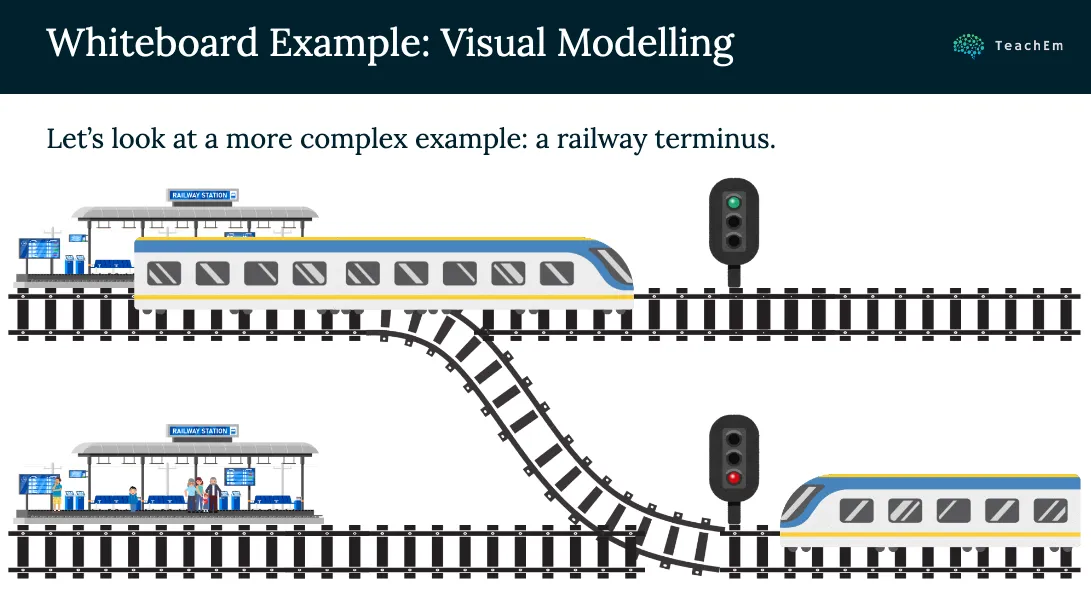
Fig. 3.3 Visual modelling: a railway terminus
What you will be able to do
Five capabilities, compounding in roughly this order.
-
Models from a blank file
Design and build discrete-event simulations in Python with SimPy: queues, resources, processes and the awkward interactions between them, in code you own and can version-control.
-
A complete working method
Not just syntax. Scoping, conceptual modelling, build, experiment and delivery; the worked projects and the client case study compress months of trial and error into days of directed progress.
-
The seven core patterns
A handful of SimPy patterns solve some ninety-five percent of simulation problems. Learn them once and recognise them everywhere, in any industry you happen to work in.
-
Production-grade habits
Structure models for maintainability, repeatability and stakeholder confidence; the difference between a clever script and a tool a business will actually bet on.
-
An asset that appreciates
New modules arrive regularly at no extra cost, for life. Most purchases depreciate the moment you make them; this one is contractually obliged to do the opposite.
Twelve modules, three projects, one method.
Over sixty video lessons, with the source code, the starter notebooks and the worked solutions to download and keep.
| Modules | What it covers |
|---|---|
| Modules 1–2 | Foundations and methodologyWhen to simulate and, just as importantly, when not to. Discrete-event simulation set beside its alternatives: agent-based models, system dynamics and fixed time steps; which tool answers which question. |
| Modules 3–6 | SimPy core masteryEnvironments, processes and events. Resources, containers and stores; priorities, pre-emption and interrupts; conditional waits. Three projects with worked solutions: a smart warehouse, a mining operation and a clinic. |
| Modules 7–8 | Professional techniquesVisual modelling: the system drawn before it is coded, and the assumptions captured from the people who run it. Then a complete client case study in cost modelling a supply chain: the brief, the scope, the conceptual model, the code and the results. |
| Module 9 | ExperimentationWhy one run is never enough: replications, Monte Carlo methods and confidence intervals. Full factorial designs and scenario comparison; recommendations that survive scrutiny. |
| Modules 10–12 | Project leadershipArchitecture for larger models: three SimPy design patterns, compared and taken apart. Scoping, the conceptual model and the assumptions register; prototypes and production models; delivering to the people who asked. |
| In the pipeline | Bonus modulesAutomated testing for simulation models; input distribution selection and fitting; advanced optimisation techniques. Included in your enrolment when they arrive. |
What students have built
- A warehouse optimisation model saving £2M annually in staffing costs
- A hospital A&E simulation that cut patient wait times by 34%
- A manufacturing line model that exposed bottlenecks worth £500K
- A supply chain simulation preventing stockouts across 50 locations
- A mining equipment scheduler that lifted utilisation by 23%
- An airport security checkpoint model handling 10,000 passengers a day
One craft; every industry.
The patterns do not care whether the queue holds patients, pallets or passenger trains.
-
Manufacturing
Production lines, bottlenecks, throughput and waste.
-
Logistics & supply chain
Routes, warehouses, networks and resilience.
-
Mining
Equipment scheduling, transport and utilisation.
-
Defence & aerospace
Mission logistics and assembly where precision is everything.
-
Healthcare
Patient flow, staffing and pathways, with no patients at risk.
-
Railway & transport
Timetables, capacity and passenger flow at network scale.
-
Oil, gas & energy
Drilling, pipelines and refineries, tested without consequence.
-
Systems & RAM engineering
Failure rates, maintenance regimes and dependability.
What your enrolment includes
- 12 modules with over 60 video lessons, every one subtitled
- 3 hands-on projects modelling real-world systems, each with a worked solution
- A complete client case study, from the brief to the results
- 9 quizzes with an explanation for every answer
- Starter notebooks, source code and a SimPy cheat sheet to keep
- Direct instructor Q&A support
- Lifetime access to all future updates
From engineers and researchers
Harry is the ultimate professional when it comes to simulation. I had the privilege of working alongside him at Anglo American, where he led the creation of a cutting-edge simulation product from scratch. Harry's ability to bridge simulation, software and systems engineering while keeping everything practical and results-focused is unmatched. If you're considering learning simulation from Harry, you couldn't be in better hands.
 Chris Samiullah Technical Programme Manager at Pydantic
Harry's expertise spans the entire simulation lifecycle; from engaging with stakeholders to gather clear requirements, to modelling, designing and developing SimPy simulations, as well as analysis and communication of results. If you wish to master every aspect of applying simulation to improve business decisions, then Harry is an expert guide.
 Dr Peter Malkin Principal Operations Researcher at CloudNC
Harry is simply a master of discrete event simulation and SimPy. I watched him build complex simulations from scratch, expertly separating the noise from what really matters. If you're thinking of learning from him; don't hesitate!
 Natalie Murray Senior Modelling and Simulation Engineer
The School of Simulation Course is a straightforward one-stop shop for working with SimPy. Worth the money when you consider the time I saved by not learning from my own mistakes!
 Connor Valentine, PhD Managing Partner at Valentine Data Solutions
Working with Harry was an incredible learning experience. His technical mastery of simulation is impressive, but what really sets him apart is his ability to align simulation projects with real-world business challenges. He's also a brilliant teacher; patient, enthusiastic and genuinely invested in helping others succeed.
 Dr Alastair Heggie Senior Modelling and Simulation Engineer
Is it for you?
Enrol if
- You can write basic Python: functions, lists, dictionaries
- Your work involves, or should involve, modelling and analysis
- You want to replace licensed software with code you control
- You are building simulation capability for a team or organisation
- You can give it two to three focused hours a week
Look elsewhere if
- You have no Python and no intention of learning any
- You need agent-based or continuous simulation (this course is discrete-event)
- You want pure theory with no projects
- You are an advanced SimPy user after niche topics only
The small print, enlarged
How much Python do I need?
A basic familiarity is plenty. If you can write a function and work with lists and dictionaries, you have everything required; the lessons concentrate on SimPy patterns rather than advanced Python. If you are not quite there, the 30-day guarantee lets you find out at no risk.
Do I have to finish it quickly?
Not at all. The course is entirely self-paced, with lifetime access and unlimited future updates. Some students finish in a week; most spread the work over a month or two at two to three hours per week; plenty treat it as a reference and dip in as projects demand.
Will it get me off expensive off-the-shelf software?
Yes; that is rather the point. By the end you will be able to build your simulations in Python with complete control over the code and no licence fees. Some students have saved their organisations over £50,000 in the first year alone.
How long does the whole course take?
Expect 20 to 30 hours in all: about seven and a half hours of video, and the rest in the quizzes, the projects and the assignments, which is where the craft is learnt. The fastest completion on record is one week; there are no prizes for matching it.
Is there a money-back guarantee?
There is: a full 30-day money-back guarantee. If the course is not what you hoped, request a refund within 30 days and you will receive one. No questions asked.
Can my employer pay?
Certainly. A VAT invoice and receipt are issued automatically at purchase, ready for reimbursement or expensing. For team enrolments, email [email protected] for volume pricing.
Training a team? Volume pricing and VAT invoices are available; email [email protected].
A short note before you decide.
This bootcamp is more than a decade of practice distilled into a programme you can work through at your own pace. The projects are drawn from real systems, the case study is a client engagement worked from brief to results and I answer student questions personally.
If it is not what you expected, the 30-day guarantee returns every penny; no hoops, no hard feelings. The only unrecoverable cost is another year of licence fees.
Harry
The Simulation Bootcamp
Black Friday £397 Everyday price £597 Until 23:59 GMT on Monday 30 November
£597
Or 3 monthly payments of £219 (opens in a new tab) The offer is on the one-payment price.
- Lifetime access
- All future updates included
- Start immediately
Secure checkout · VAT invoice provided · 30-day money-back guarantee