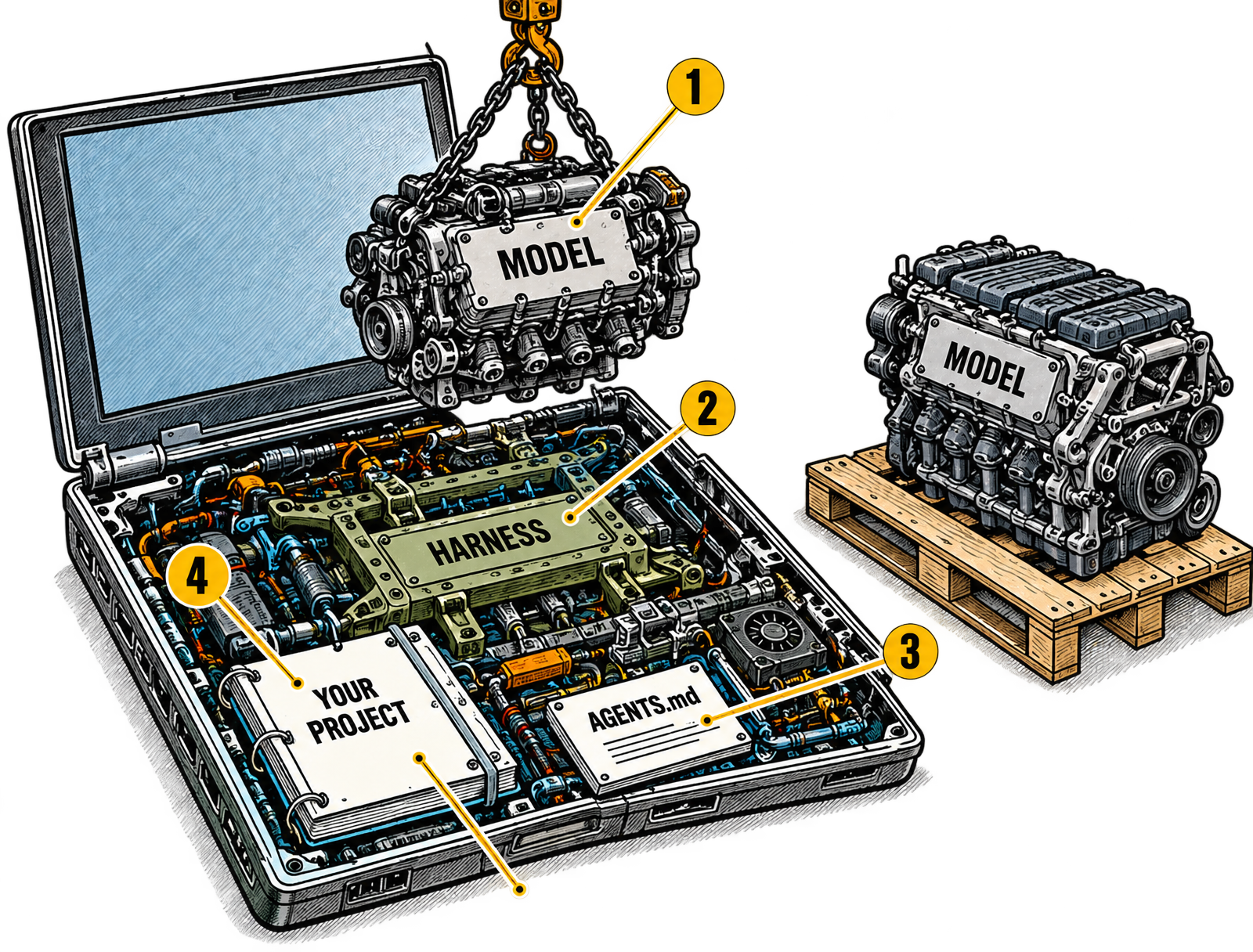
Agentic Engineering for the Rest of Us
A Non-Developer’s Guide to Coding Agents
Don’t marry the model. A practical, opinionated guide to the four AI coding agents worth learning - Claude Code, Codex, OpenCode and Pi - for people who build things with these tools rather than build the tools.
Out now, direct from the author
476 pages PDF + EPUB DRM-free $20
Get the bookPaperback and hardback on Amazon now. Or read Chapters 1 to 3 free first.
Section 1: The route
-
Level 1: Chat bot
You ask, it answers, you copy the useful bits.
-
Level 2: Coding agent
One agent in your project folder; you steer it and check what it did.
-
Level 3: Parallel coding agents
Several agents at once; you hand out the work and review it.
-
Level 4: Agent orchestration
Something runs the agents for you; you brief the system.
Each level stands on the one below, and you climb only when the work in front of you demands the next. Most readers never reach the top; that’s by design.
Section 2: The free sample
Not sure yet? The first three chapters, as PDF and EPUB, free. They set up everything that follows: where the words are going, what happened in June, and what a harness actually is.
-
Chapter 1: From Vibe Coding to Agentic Coding
Where the language is going, and what I learnt from a reader review that told me my last book’s details would date.
-
Chapter 2: Eighteen Days
The Fable 5 export-control saga as it happened, and why it makes lock-in a personal risk rather than an abstract one.
-
Chapter 3: Harnesses
The word nobody’s explained to you, the four personalities, and why I tell you to skip browser app-builders.
Get Chapters 1 to 3 free (PDF and EPUB)
You’ll get the sample straight away, as PDF and EPUB.
Ready for the whole thing? Get the book, $20
Section 3: Specifications
The details will date. The principles are sound.
So the book quarantines the perishable facts in dated Field Guides and teaches the parts that don’t move: how to brief an agent, how to check its work, how to hand over a task and walk away safely. The model underneath becomes a setting, not a commitment.
| Harness | Its job | Where you meet it |
|---|---|---|
| Claude Code | Collaboration | First: one good conversation, done properly |
| Codex | Delegation | Once you start handing work over |
| OpenCode | Freedom | Near the end, where portability is the point |
| Pi | Control | Near the end, where portability is the point |
Section 4: The free library
Every book on the shelf is free. The only price is an email address.
-
 Claude Code for the Rest of Us eBook Twenty-three chapters for people who build with AI but would not call themselves developers. Start here if all of this is new.
 -
 The Ralph Loop eBook + EPUB A practitioner’s guide to autonomous AI coding, from fresh-context theory to troubleshooting.
 -
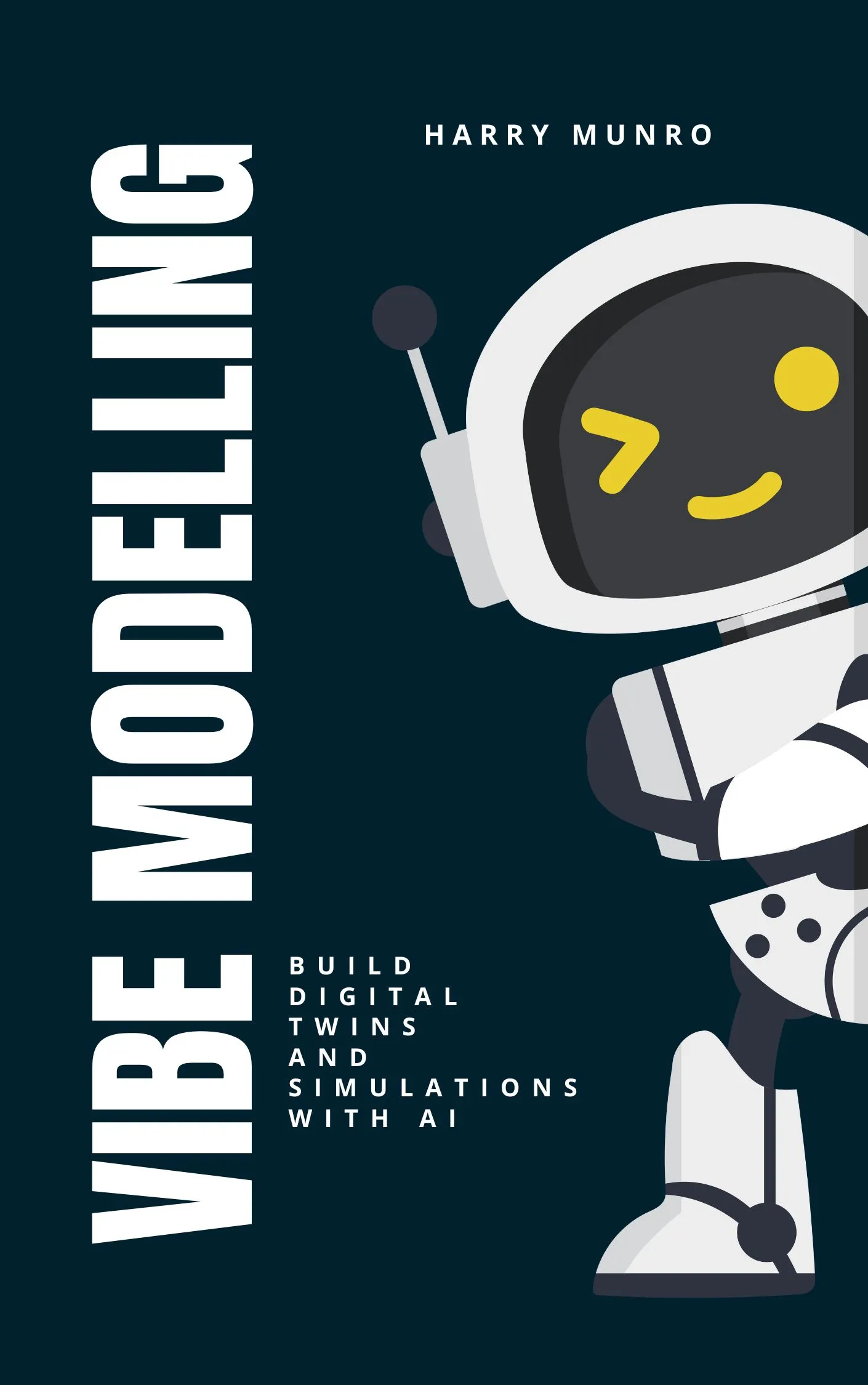 Vibe Modelling eBook Build digital twins with AI assistance; a six-step framework that asks for no code at all.
 -
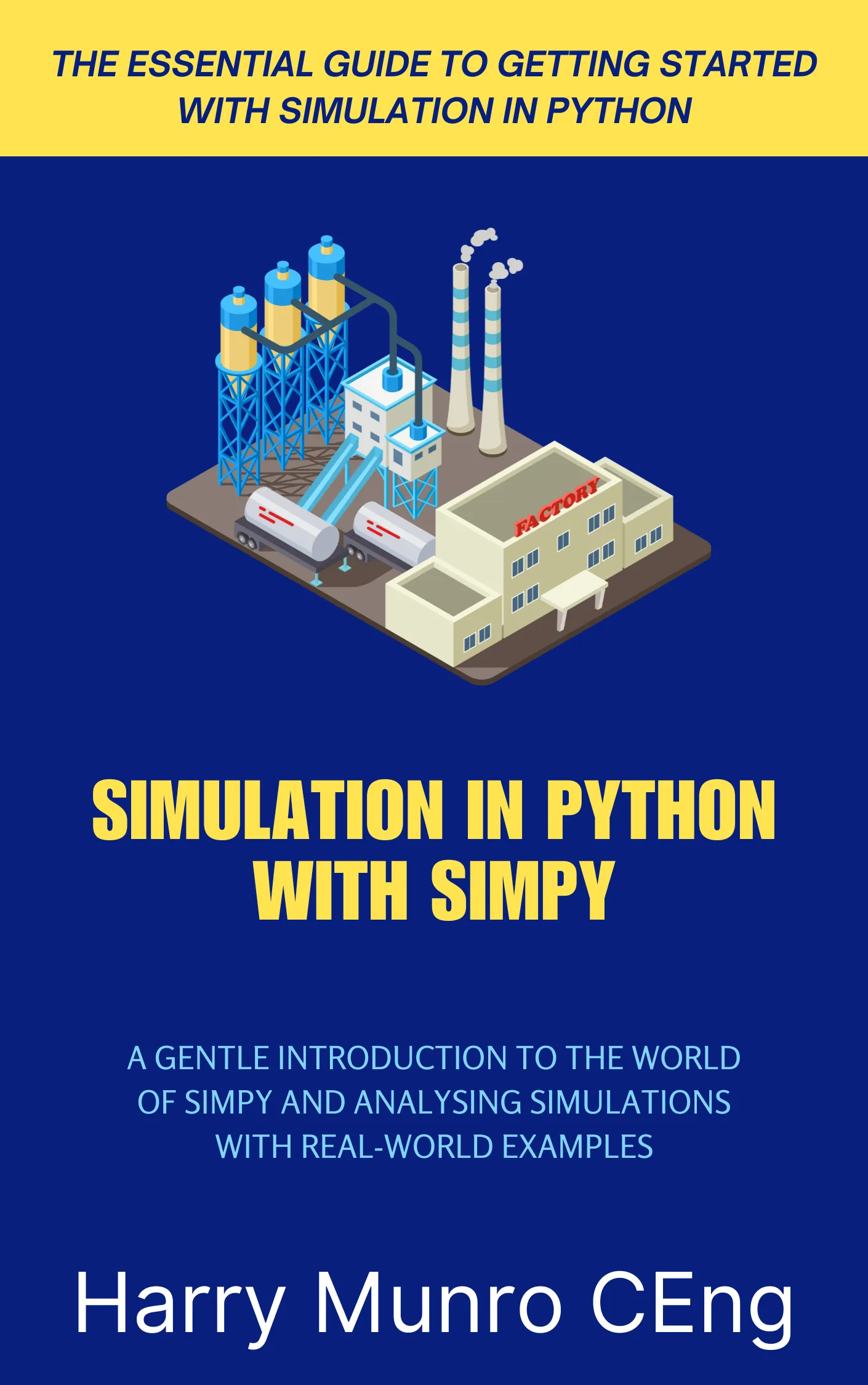 The SimPy Handbook eBook + runnable code The patterns behind almost every discrete-event model, with code you can run tonight.
 -
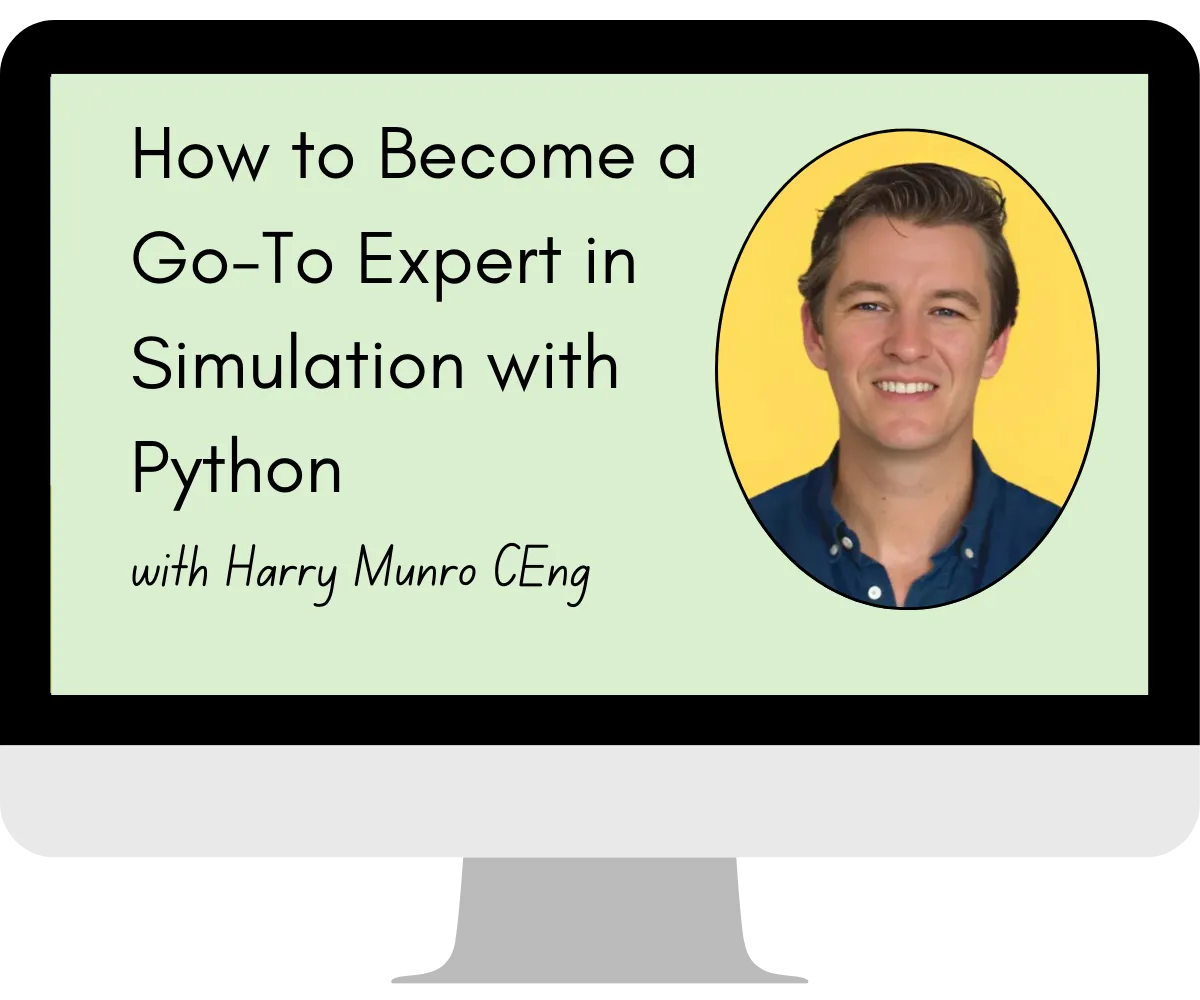 The Free Masterclass 40-minute recording Watch a factory simulation built from nothing, and see how a simulation study is actually run.
Section 5: Where the rigour comes from
Before the agents, there were models. The school began with discrete-event simulation in Python, and the discipline carries straight across: build it, test it, defend it.
Spreadsheets average away the chaos; licensed software hides it behind a seat fee. The courses teach you to build models in Python with SimPy that you own, understand and can defend.
Fig. 5.1 is not a video. It is a discrete-event model of a Saturday checkout, running live in your browser. Close a till; see what it costs.
A live simulation of customers queueing for supermarket tills. Use the buttons to open or close tills and see how the queue responds.
tills = simpy.Resource(env, capacity=2)
Queue length, live
- Clock
- 09:00
- Queue
- 0
- Served
- 0
- Wait, last 20
- –
- Tills busy
- 0 / 2
Try it: close a till and watch Saturday fall apart.
The courses
| Course | What it covers | Price |
|---|---|---|
| The Simulation Bootcamp | The flagship. Fourteen modules, sixty lessons and six real projects, from your first SimPy process to studies that stand up in the boardroom. | £597 |
| Data Science Mastery | Pandas, statistics and machine learning with Dr Ron Erez, so raw model output becomes a defensible conclusion. | £297 |
| 10-Day Python Bootcamp | Python for engineers and scientists in ten days of short, deliberate lessons. | On Udemy |
Section 6: The author

Section 7: Service record
What students and colleagues say about Harry’s simulation teaching.
Harry consistently impressed me with his mastery of both the technical side of simulation modelling and coding as well as the nuanced aspects of simulation project management. He possesses a rare combination of modelling expertise and a keen understanding of how to translate complex business needs into effective simulation models. His leadership, focus on results and exceptional communication skills make him an ideal person to learn from.
 Rory Greig Research Engineer at Google DeepMind
 Harry is simply a master of discrete event simulation and SimPy. I watched him build complex simulations from scratch, expertly separating the noise from what really matters. If you're thinking of learning from him; don't hesitate!
 Natalie Murray Senior Modelling and Simulation Engineer
 The School of Simulation Course is a straightforward one-stop shop for working with SimPy. Worth the money when you consider the time I saved by not learning from my own mistakes!
 Connor Valentine, PhD Managing Partner at Valentine Data Solutions
 Don’t marry the model. The book is out now.
Agentic Engineering for the Rest of Us
476 pages · PDF + EPUB · DRM-free · $20
Get the bookPaperback and hardback on Amazon now. Or read Chapters 1 to 3 free first.